


This is one of the most common payroll questions we get from Indianapolis employers, and one of the most common payroll mistakes we find. Your office is in Marion County. Your employee drives in from Carmel, Fishers, or Noblesville every day. Which county gets the tax?
Short answer: Hamilton County. Here’s why, and where it gets trickier.
The rule: residence on January 1 wins
Indiana county income tax follows the employee, not the office. Employers withhold county tax based on the employee’s Indiana county of residence as of January 1 of the tax year. Indiana Capital Chronicle
The county where they work only comes into play if they don’t live in Indiana. If the employee lives out of state on January 1 but their principal place of work is an Indiana county on that date, you withhold for the county where they work. Paylocity
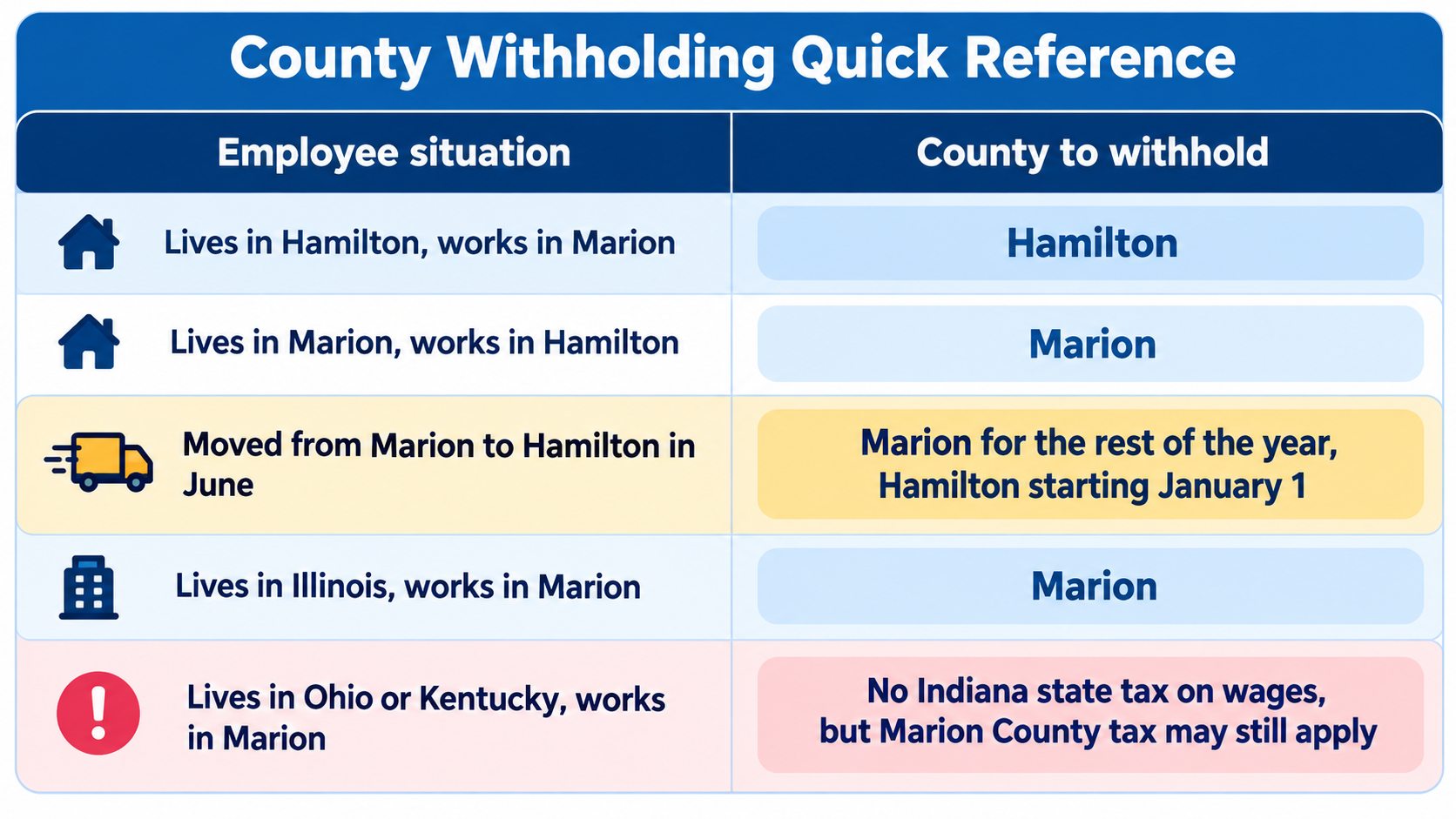
So for an employee living in Hamilton County and working in Indianapolis, you withhold Hamilton County tax. Marion County doesn’t enter the picture.
Why getting it wrong matters
The two rates aren’t close. For 2026, Marion County’s rate is 2.02%, and Hamilton County’s is 1.10%. USTaxTools
On an $80,000 salary, that’s $1,616 withheld at the Marion rate versus $880 at the Hamilton rate. Pull Marion by mistake, and your employee is overwithheld by $736 for the year. They’ll get it back when they file, but they’ll also ask why their paycheck was short all year, and your W-2 will report the wrong locality.
The reverse happens too. An employee who lives in Marion County and works at your Hamilton County location should have Marion withheld. Default to the office county and you underwithhold, and the employee gets a bill in April they didn’t plan for.
Keep in mind the county tax sits on top of the state tax. Indiana’s state withholding rate dropped to 2.95% from 3% on January 1, 2026. PayrollOrg
What happens when an employee moves mid-year
Nothing changes until next January. The county is set by the employee’s residence on January 1, and withholding doesn’t change until January 1 of the following year, even if they move during the year. Thomson Reuters
If your employee moves from Indianapolis to Westfield in June, keep withholding Marion County for the rest of the year. Have them fill out a new Form WH-4 with the new address, then switch to Hamilton County for the first payroll in January.
This is where payroll systems often go wrong. Update the address in the middle of the year and many systems will switch the county right away. Check yours.
What about employees from other states?
If an employee lives outside Indiana, the county they work in on January 1 determines the county tax. An Illinois resident working at your Indianapolis office gets Marion County withholding.
Employees from reciprocal states are a special case. Residents of Kentucky, Michigan, Ohio, Pennsylvania, and Wisconsin pay their home state on Indiana wages, but reciprocity does not cancel Indiana county tax, which can still apply based on their January 1 county of employment. Don’t assume a reciprocity certificate means zero Indiana withholding. iReside
Rates change every year, so check every December
Counties can and do change their rates. The Indiana Department of Revenue publishes the full county schedule each October in Departmental Notice #1, with a December update for any county that voted a change before January 1. Six counties raised their rates for 2026. TeamedPayrollOrg
Before your first January payroll, confirm the rate for every county your employees live in. If you have staff spread across Hamilton, Marion, Boone, Hendricks, Johnson, and Hancock, that’s six rates to check.
A bigger change is coming
Indiana’s local income tax system is getting rebuilt. The 2025 property tax law, Senate Enrolled Act 1, capped total local income tax rates at 2.9% per county, down from 3.75%, and allows cities and larger towns to impose their own rates of up to 1.2% within that county total, which they’ve never been able to do before. Indiana Capital Chronicle
That was supposed to start in 2028. House Enrolled Act 1210 pushed the effective date to 2029. Lawmakers are expected to revisit the details in the 2027 session. Aim Indiana
For employers, the practical effect is that “which county” may eventually become “which county and which city.” Withholding could depend on whether an employee lives in Carmel versus unincorporated Hamilton County. The details aren’t final yet, but it’s worth knowing that county-level payroll setup likely won’t be enough a few years from now.
A bigger change is coming
Indiana’s local income tax system is getting rebuilt. The 2025 property tax law, Senate Enrolled Act 1, capped total local income tax rates at 2.9% per county, down from 3.75%, and allows cities and larger towns to impose their own rates of up to 1.2% within that county total, which they’ve never been able to do before. Indiana Capital Chronicle
That was supposed to start in 2028. House Enrolled Act 1210 pushed the effective date to 2029. Lawmakers are expected to revisit the details in the 2027 session. Aim Indiana
For employers, the practical effect is that “which county” may eventually become “which county and which city.” Withholding could depend on whether an employee lives in Carmel versus unincorporated Hamilton County. The details aren’t final yet, but it’s worth knowing that county-level payroll setup likely won’t be enough a few years from now.
Quick Reference
Not sure your payroll is set up right?
If you have employees commuting across county lines, it takes about ten minutes to check whether each one is coded to the right county. It takes a lot longer to fix a year of W-2s after the fact.
Smart CFO works with Indianapolis-area businesses on payroll, bookkeeping, and the financial reporting that sits on top of them. If you’d like a second set of eyes on your setup before year-end, book a free consultation.